
Why Freshwater Pearls Aren't Perfect... And That's Exactly Why They're Beautiful
A lovely customer emailed me recently after receiving one of our freshwater pearl pendants. She told me how much she loved it, but she'd noticed that one of the pearls wasn't perfectly smooth.
"Have I received a faulty one?" she asked.
I smiled when I read her email because it's a question I hear quite often. In fact, the tiny differences she noticed are often one of the things that make genuine freshwater pearls so special.
We often think of pearls as perfectly round, smooth and identical because that's how they're shown in magazines and advertisements. Real freshwater pearls are different. They are created by nature, and nature has never been in the business of making perfect copies.
How Freshwater Pearls Are Formed
Unlike gemstones that are cut and polished from rock, pearls are formed inside living freshwater mussels. Over time, the mussel coats a tiny particle with layer upon layer of nacre, the beautiful substance that gives pearls their unmistakable glow.
Every mussel is different, every growing environment is different and every pearl develops in its own way. That's why no two freshwater pearls are ever exactly alike.
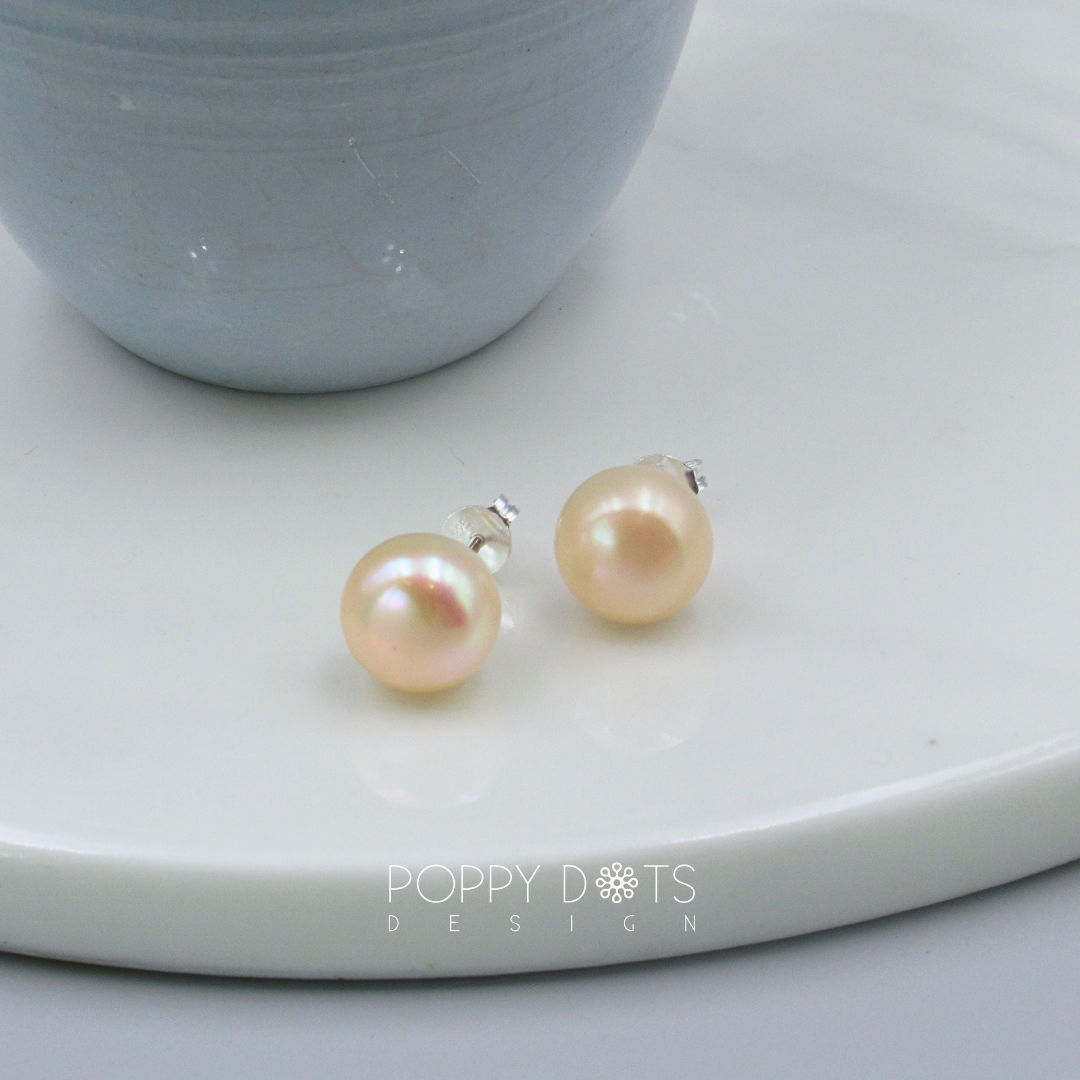
Some are beautifully round, while others have a softer oval shape. Some have tiny dimples or gentle growth rings, and some reflect the light a little differently from their neighbours. These natural characteristics are part of the pearl itself. They are not signs that something has gone wrong.
Why No Two Pearls Look Exactly the Same
One of the reasons I love freshwater pearls is that each one has its own personality.
When selecting pearls for Poppy Dots Design, I'm not looking for machine-made perfection. I'm looking for beautiful lustre, lovely colour and pearls that work beautifully together in a finished piece of jewellery.
If you compare two genuine freshwater pearls side by side, you'll almost always notice subtle differences. One may be slightly rounder, another may have a tiny natural marking, while another catches the light just a little differently.
Those differences are exactly what you'd expect from something created by nature.
Are Surface Marks Normal?
Yes, they are.
Tiny growth marks, gentle ridges and small dimples are all natural characteristics that can occur as a pearl forms. Professional pearl graders expect to see these variations because they are part of the way freshwater pearls develop.
That doesn't mean every pearl should have obvious imperfections. Quality still matters. Pearls are carefully selected for their lustre, colour and overall appearance before they become part of a piece of jewellery.
It's simply worth remembering that natural doesn't mean flawless, and flawless isn't necessarily what makes something beautiful.
Natural Characteristics and Damage Are Not the Same Thing
There's an important difference between a natural characteristic and damage.
A slight ripple or a tiny growth mark formed while the pearl was growing inside the mussel. It's part of the pearl's story.
Damage happens afterwards. Chips, cracks or peeling nacre are signs that a pearl has been damaged through impact or wear.
If you're ever unsure about a pearl you've purchased, don't hesitate to ask the jeweller. A reputable jeweller should always be happy to explain what you're seeing and answer your questions.
Why Matching Pearls Takes Time
Creating a beautiful pair of pearl earrings or a perfectly balanced necklace is more complicated than many people realise.
Even pearls that are similar in size can vary slightly in shape, colour and lustre. Matching them so they look harmonious takes time, patience and a careful eye.
It's one of the reasons quality pearl jewellery feels so special. You're not looking at identical pieces made by a machine. You're looking at carefully selected natural pearls that complement one another beautifully.
A Little About Me
I've been involved in the jewellery industry for many years, and one of the things I enjoy most is helping people understand the materials they're wearing.
Whether it's sterling silver, freshwater pearls or natural gemstones, I believe jewellery becomes even more meaningful when you know a little about its story.
The more you understand about the materials, the easier it becomes to recognise quality and choose pieces you'll enjoy wearing for many years.
The Beauty of Nature
I've always believed that jewellery should be worn, loved and one day passed on.
Some of the most beautiful things in nature aren't perfectly symmetrical or completely flawless, and freshwater pearls are a wonderful example of that.
Every pearl has taken years to form.
Every pearl is slightly different.
Every pearl has its own quiet character.
The next time you notice a tiny ripple, a gentle dimple or a subtle variation in shape, I hope you'll see it for what it really is. Not a flaw, but a reminder that you're wearing something nature created, slowly and beautifully, long before it became part of your jewellery collection.
And to me, that's what makes freshwater pearls so timeless.